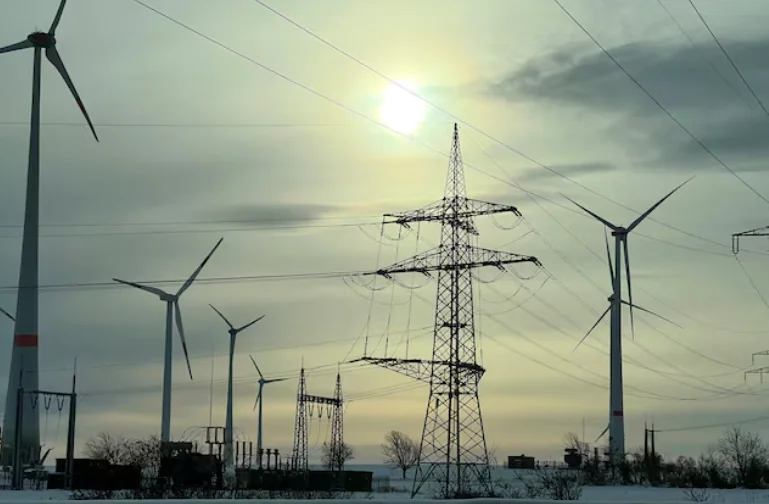
According to the estimate of European Commission, around €584 billion is needed to invest in electricity grids in Europe in the current decade.
That is a huge amount of money, however, there is an easy explanation for this fact.
Growing electricity demand in Europe is anticipated due to the increasing consumption of electric vehicles, heat pumps and electric-based processing of industry. In parallel, the usage of renewables like solar and wind is on an upward trend.
However, the problem is that the electricity grid must also cope with growing electricity consumption.
European Commission claims that around 40% of distribution grids in Europe are already more than 40 years old.
While new power generation capacities are needed, the electricity must be delivered from the place of generation to the place of consumption.
Thus, even if a wind farm or a solar project is ready to produce electricity, there may be not enough grid capacity in the area to connect it to the grid.
The situation with using electricity by businesses and industries is similar. Companies and industries may have money and the necessary plan for implementation of their projects but may still have to wait for the suitable grid connection.
Moreover, building new substations and power lines is a time-consuming process as well. Planning, permits, and equipment shortages are among factors which may slow down the projects.
As a result, when we consider the issue of energy transition, very often the question of electricity generation is discussed.
However, another question is equally important and is: Is it possible for Europe to deliver electricity around the continent?
Sources:
European Commission - European grids
European Commission - Smart grids and meters
More About the Research
Why does Europe need so much grid investment?
When people think about the energy transition, the first thing that often comes to mind is electricity generation: solar panels, wind turbines, nuclear power plants and other sources of electricity.
But generating electricity is only one part of the system.
Once electricity has been produced, it needs to travel through transmission and distribution networks before reaching homes, businesses and industrial facilities. Those networks need to have enough capacity to handle the electricity being generated as well as the electricity being consumed.
The European Commission estimates that around €584 billion of electricity infrastructure investment was needed between 2020 and 2030, particularly in distribution grids, to support the EU's renewable-energy and energy-efficiency objectives.
This is therefore not simply a question of building more power plants. Europe also needs to expand, modernise and digitalise the infrastructure that connects electricity producers with consumers.
An ageing distribution network
One of the interesting points highlighted by the European Commission is the age of Europe's distribution grids.
Around 40% of EU distribution grids are more than 40 years old. At the same time, electricity systems are being asked to handle new types of demand, including electric vehicles, heat pumps, industrial electrification and other technologies that increase electricity consumption.
Older infrastructure does not automatically mean that a grid is unsafe or unusable. However, networks designed for an earlier electricity system may need significant upgrades if they are expected to accommodate much larger amounts of distributed generation and new electricity demand.
This is one reason grid investment can become a bottleneck for the energy transition.
Solar and wind create a different challenge
Renewable electricity generation is not necessarily located where electricity demand is highest.
A large solar installation might be built in an area with excellent solar resources, while a wind farm might be located where wind conditions are particularly favourable. But the electricity may ultimately be needed somewhere else.
The European Commission specifically notes that renewable projects are frequently located where conditions are most suitable rather than necessarily close to centres of demand or areas where the grid is already sufficiently reinforced.
That creates a connection problem.
A project can be technically ready to generate electricity, but the local network may not have enough capacity to accept the additional power. In other situations, an industrial facility or other large electricity consumer may be ready to connect but have to wait for network reinforcement.
This is why electricity generation capacity and grid capacity have to be developed together.
Connection delays can affect both producers and consumers
The problem isn't limited to renewable-energy companies.
A factory that wants to electrify part of its production may require a much larger electricity connection. A data centre can require substantial amounts of electricity. Households adopting heat pumps and electric vehicles can also increase demand at the distribution level.
The Commission has identified insufficient grid capacity as a challenge affecting connection requests from both the supply and demand sides. It has also highlighted delays in project implementation as one of the problems facing European power networks.
This creates a situation where investment in one part of the energy system can run ahead of investment somewhere else.
Why can't Europe simply build more power lines?
Building electricity infrastructure is considerably more complicated than simply installing cables.
New substations, transmission lines and distribution infrastructure generally require planning, engineering, land access, equipment and regulatory approvals. Projects can therefore take years from initial planning to completion.
The European Commission has specifically identified permitting delays, supply-chain constraints and the need for stronger planning as issues affecting grid development. Its 2025 guidance on anticipatory investment also highlighted the growing problem of connection delays.
There is also a planning dilemma.
If a grid operator waits until a new wind farm, factory or data centre is already ready to connect, network expansion may come too late. But investing far in advance also creates uncertainty about exactly where future electricity generation and demand will appear.
This is why the Commission has been promoting anticipatory investment — building some network capacity ahead of confirmed connection requests where future demand or generation is sufficiently foreseeable.
The challenge extends beyond 2030
The €584 billion figure is important, but it should not be interpreted as the final amount Europe will ever need to spend on electricity networks.
More recent European Commission estimates point to a much larger investment requirement through 2040. The Commission estimates roughly €730 billion for distribution grids and €477 billion for transmission grid developments through 2040, including offshore grid developments.
The Commission's 2025 European Grids Package also refers to approximately €1.2 trillion in electricity-grid investment by 2040, including distribution and transmission infrastructure.
So the issue is becoming a long-term infrastructure challenge rather than simply a short-term spending requirement.
Smart grids could help
Not every solution requires building completely new infrastructure.
Digitalisation can allow electricity networks to be managed more intelligently. Smart meters, for example, can provide more detailed information about electricity consumption, while digital technologies can help network operators understand how different parts of the grid are being used.
Better information can help operators manage demand, identify problems and plan future investments.
The Commission is also supporting the development of more digitalised and flexible networks, including work on technologies such as digital grid twins and AI-based grid management.
The missing piece of the energy-transition discussion
This is perhaps the most important point.
A country can build enormous amounts of solar and wind generation, but those projects cannot deliver their full potential if the electricity network cannot connect them or move the electricity to where it is needed.
Likewise, electrifying transport, heating and industry increases the importance of having a network capable of delivering electricity reliably.
The European Commission itself describes grids as central to the energy transition and says that insufficient grid capacity can constrain the expansion of the electricity system.
So when discussing Europe's future energy system, there are really two connected questions:
How much clean electricity can Europe generate?
And:
Can Europe build and operate the networks needed to deliver that electricity where and when it is required?
The second question may not be as visually impressive as a new wind farm or solar park, but it is an essential part of making the whole electricity system work.
References
European Commission. European grids.
European Commission : European gridsEuropean Commission. Smart grids and meters.
European Commission: Smart grids and metersEuropean Commission. EU guidance on ensuring electricity grids are fit for the future. (2025)
European Commission: Electricity grids guidanceEuropean Commission. Commission collects views in preparation of the European Grids Package. (2025)
European Commission: European Grids PackageEuropean Commission. Commission launches strategy to accelerate clean energy investment. (2026)
European Commission: Clean energy investment strategy