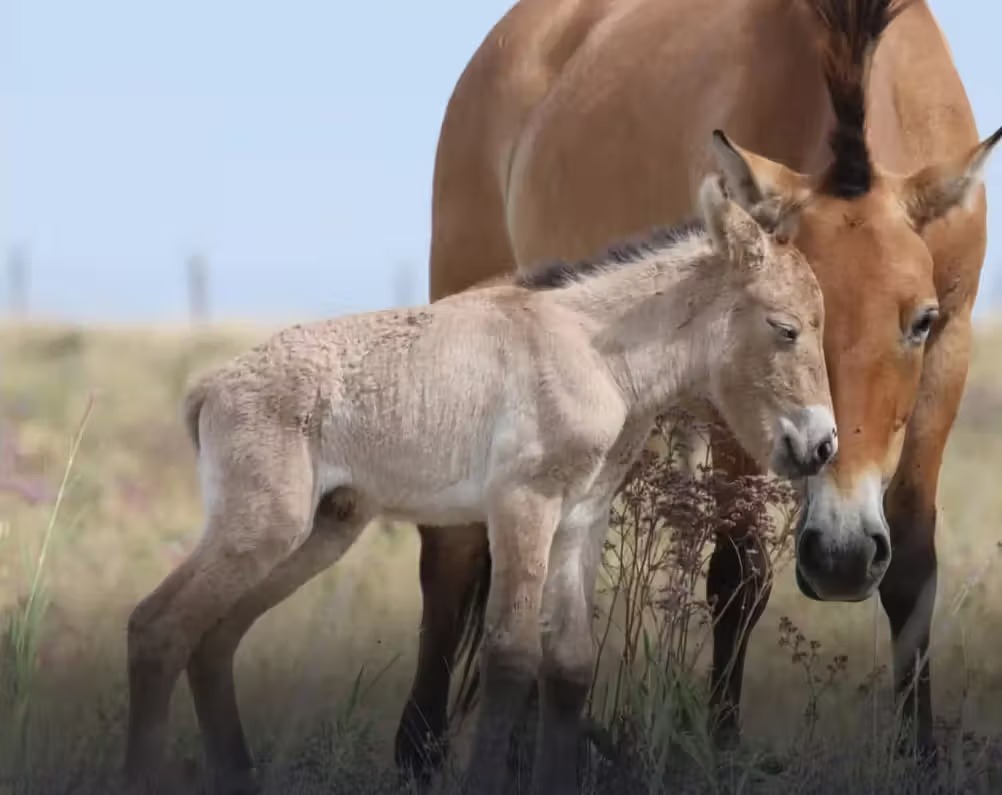
The birth of a Przewalski’s horse for the first time in more than 200 years in central Kazakhstan makes history. The foal was born on August 22, 2026, at the Alibi Reintroduction Centre in the Altyn Dala State Nature Reserve and is male.
There is a lot of confusion when it comes to Przewalski’s horse because it is considered the only true wild horse in the world, as it has never undergone domestication like other horses.
The species vanished from the wild in the last century when the final wild population of the species went extinct in the late 1960s because of hunting, habitat destruction and competition with domesticated animals.
This foal is the first baby of the Przewalski’s horses that have been returned to Kazakhstan under the international reintroduction project. The reestablishment process began in 2024 after a period of two centuries during which no Przewalski’s horse had been seen in Kazakhstan.
Tessa, the mother of this young horse, was brought to Kazakhstan as part of the first group, and Zorro was brought from a breeding programme based at Prague Zoo in the Czech Republic. They were able to reproduce after being brought to Kazakhstan and the foal was born. Tessa and her foal are considered to be healthy by conservationists.
The foal was able to walk and nurse shortly after being born, and at present, Tessa and her foal are under close observation by conservationists. This is a very important event because reproduction is one of the foremost steps towards successfully creating a self-sustaining population.
The goal of the Return of the Wild Horses project is to create a self-sustaining population of this species that can live and breed naturally in Kazakhstan. Furthermore, the project is essential in the context of restoring the natural ecosystems of the region.
As a large herbivore, Przewalski’s horse could contribute to restoring the ecosystem naturally. Thus, the birth of one little horse is very important not only because of this particular animal but also because it demonstrates that even a species that was once lost in the wild has a chance to survive again in the region.
Reference:
Fauna & Flora. (2026, August 26). Celebrating Kazakhstan’s first wild-born Przewalski’s horse in 200 years. Fauna & Flora articleKazakhstan,
More About the Research
Why is the birth so important?
At first glance, the birth of a single foal might not seem like something that could have much significance for an entire species. In conservation, however, reproduction is one of the most important signs that a reintroduction programme is beginning to work.
The male foal was born on 22 August 2026 at the Alibi Reintroduction Centre in Central Kazakhstan. According to Fauna & Flora, both the foal and his mother, Tessa, were doing well and were being monitored by veterinary and conservation teams.
Even more importantly, the foal was conceived after the horses were brought to Kazakhstan. His father, Zorro, was part of the first group of Przewalski’s horses introduced to the country in 2024. This means reproduction has already occurred during the early stages of the reintroduction programme.
A species that came remarkably close to disappearing
Przewalski’s horse has an extraordinary conservation history.
The species became extinct in the wild during the 1960s. The last confirmed wild sightings were in Mongolia, and subsequent surveys found no remaining wild population. Fortunately, a small captive population survived and became the foundation for later breeding and reintroduction efforts.
The recovery of the species is therefore one of the better-known examples of how captive breeding and reintroduction can work together.
The IUCN has described Przewalski’s horse as the last remaining truly wild horse. Following successful conservation efforts, its status changed from Extinct in the Wild to Critically Endangered and subsequently to Endangered.
This history is particularly important because the horses living today ultimately descend from a very small founding population. Maintaining genetic diversity is therefore an important part of long-term conservation.
Why return the horses to Kazakhstan?
Kazakhstan was historically part of the range of Przewalski’s horse, but the species had been absent from the country for roughly two centuries.
The Return of the Wild Horses programme began reintroducing the animals to Kazakhstan in 2024. The horses first spend time in large acclimatisation enclosures before being released, allowing them to adjust to the local environment and conditions.
The programme is taking place within the much larger Altyn Dala conservation landscape, an enormous area of steppe, desert and wetland habitats.
The idea is not simply to place a few horses in a protected area. The long-term objective is to establish a population that can survive, reproduce and eventually grow without depending entirely on human intervention.
The ecosystem connection
Przewalski’s horses are large grazing herbivores, so their return could have effects beyond the species itself.
Large herbivores interact with grasslands through grazing, movement and nutrient cycling. Their presence can form part of the natural ecological processes of a steppe ecosystem. This is why species reintroduction projects are increasingly considered as part of broader landscape restoration rather than simply attempts to increase the number of individual animals.
Fauna & Flora describes the return of Przewalski’s horse as part of a wider effort to restore Kazakhstan's native steppe ecosystems. The Altyn Dala initiative is also working on the conservation of other important species and habitats across a huge area of Central Kazakhstan.
The difficult part comes next
The birth is an encouraging milestone, but it does not mean that the conservation project has already succeeded.
A self-sustaining population requires many animals capable of reproducing over multiple generations. Conservationists also have to monitor population size, genetics, health, food availability, habitat conditions and interactions with other species.
There are additional challenges associated with reintroduced Przewalski’s horses. Historical conservation literature has highlighted concerns including small population size, genetic management, disease and possible hybridisation with domestic horses.
That is why the project involves long-term monitoring rather than simply releasing the animals and leaving them completely alone.
A remarkable conservation story
Perhaps the most fascinating part of this story is that Przewalski’s horse has already demonstrated that extinction in the wild does not necessarily have to be the final chapter.
The species disappeared from the wild, survived through captive breeding and was subsequently returned to natural habitats. Reintroduction programmes in Mongolia played an important role in that recovery, and Kazakhstan is now becoming another part of the species' return to its historical range.
The 2026 foal is therefore much more than just a newborn horse.
He represents the first new generation produced by the Kazakhstan reintroduction programme. His survival and eventual ability to reproduce will be important pieces of evidence as conservationists determine whether a genuinely self-sustaining population can eventually become established.
For now, the story is a small but significant step in a much larger conservation effort: a species that disappeared from Kazakhstan generations ago is once again being born on the Central Asian steppe.
References
Fauna & Flora. (2026, August 26). Celebrating Kazakhstan’s first wild-born Przewalski’s horse in 200 years.
Fauna & FloraIUCN. (2018). From extinction to free ranging by successful reintroduction: 25th anniversary of the reintroduction of Przewalski’s horse.
IUCNIUCN. Przewalski’s Horse: conservation and reintroduction information.
IUCN Species Survival CommissionIUCN. Przewalski’s Horse Global Conservation Plan.
IUCN LibraryFauna & Flora. De-extinction and reintroduction: what's the difference?
Fauna & Flora