So why is it difficult for job applicants to find work?
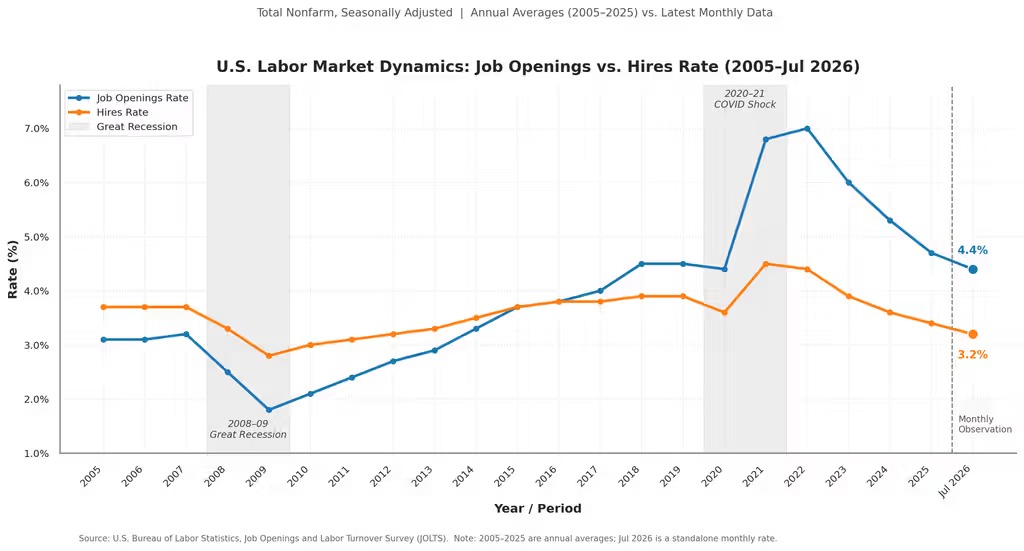
The statistics provided by the U.S. Bureau of Labour Statistics (BLS) are thought-provoking. In July 2026, there were 7.3 million job openings, whereas only 5.1 million hires were recorded that month. So, at first glance, it looks like there are millions of jobs waiting to be filled. However, that's not exactly how it works because job openings are counted at one point in time, whereas hires are counted over a one-month period.
The long-term trend is even more interesting. Hiring rates have slowed down considerably compared to the post-COVID period. During 2021–2022, companies were hiring aggressively in a highly competitive labour market. That environment is largely gone now.
There are still millions of job openings in the U.S. However, companies seem to be taking a more conservative approach to hiring.
Hence, we are facing a new type of labour market. While there are plenty of job openings available, job seekers are still struggling to secure employment.
This is a bigger issue for the labour market than simply saying, "There are 7 million job openings."
A job opening does not necessarily mean that an employer is going to hire someone immediately.
Source:
BLS JOLTS July 2026 release - for the specific July figures.
JOLTS official data page - for the broader JOLTS dataset and historical data.
More About the Research
The 7.3 million versus 5.1 million comparison can be misleading.
The first thing to understand is that the two numbers measure different things.
According to the BLS, job openings are measured on the last business day of the month. In July 2026, there were about 7.3 million openings at that point in time. Hires, on the other hand, represent people who were added to payrolls during the entire month. There were about 5.1 million hires in July.
That means we cannot simply subtract 5.1 million hires from 7.3 million openings and conclude that 2.2 million jobs were left unfilled.
There is another important detail. For a position to be counted as a job opening in JOLTS, the employer must have a specific position available, the job must be able to start within 30 days, and the employer must be actively recruiting workers from outside the organisation.
So these are genuine vacancies, but they are not a list of guaranteed job offers waiting for applicants.
The labour market really was much hotter after COVID
The difference becomes clearer when we look back at 2021 and 2022.
In 2021, job openings reached a series high of 11.4 million in December, while quits also reached a series high during the year. The labour market was experiencing unusually high turnover and strong demand for workers.
The strength continued into 2022. BLS reported an annual average of 11.2 million job openings in 2022, compared with 10.0 million in 2021. There were also 77.2 million hires during 2022. However, BLS noted that hiring growth slowed as the year progressed.
The situation changed noticeably in 2023. The annual average number of job openings fell to 9.4 million, while annual hires declined to 71.0 million, a decrease of 5.8 million from 2022. BLS described the overall labour market as cooling.
What does the labour market look like now?
The July 2026 figures show a much less dynamic environment than the extraordinary period immediately following the pandemic.
There were 7.3 million job openings and 5.1 million hires in July. The hires rate was 3.2%, while the job openings rate was 4.4%. Quits were 3.1 million, representing a quits rate of 1.9%.
The Federal Reserve's July 2026 assessment also described the labour market as having stabilised following a period of cooling. It noted that layoffs had remained subdued and job vacancies had been roughly flat overall.
This helps explain why the labour market can feel difficult for job seekers even when millions of openings exist.
Why can job seekers still struggle?
One reason is that the headline number of vacancies does not tell us how accessible those jobs are to every applicant.
Job openings can be concentrated in particular industries, occupations, locations, experience levels and skill requirements. A person searching for an accounting position in one city, for example, cannot necessarily compete for a healthcare position in another state simply because both positions are included in the national total.
There is also competition between applicants. An opening can attract many applications, meaning that having millions of vacancies nationally does not mean every individual applicant has millions of opportunities available to them.
And employers can take time to evaluate candidates, conduct interviews, change hiring plans or leave a position open while searching for someone with particular qualifications.
The bigger picture
The most useful way to understand the current labour market is therefore not simply to look at the number of job openings.
Job openings tell us that employers are actively recruiting for positions at a particular point in time. Hires tell us how many people actually joined payrolls during the month. Quits, layoffs, unemployment, wage growth and other measures provide additional information about how the labour market is functioning.
So, when someone asks, "If there are 7 million jobs available, why can't I find one?", the answer is more complicated than the headline number suggests.
There can be millions of legitimate job openings while individual job seekers still face strong competition, mismatches between their skills and available positions, geographic limitations, and employers that are hiring more cautiously than they did during the post-COVID boom.
That is what makes the current labour market so interesting: a large number of job openings does not automatically translate into an easy job search.
References
U.S. Bureau of Labour Statistics. (2026). Job Openings and Labour Turnover Survey — July 2026.
https://www.bls.gov/news.release/jolts.htmU.S. Bureau of Labour Statistics. Job Openings and Labour Turnover Survey (JOLTS).
https://www.bls.gov/jlt/Huang, V., & Cheng, E. P. (2024). Job openings and hires decline in 2023 as the labour market cools. Monthly Labour Review, U.S. Bureau of Labour Statistics.
https://www.bls.gov/opub/mlr/2024/article/job-openings-and-hires-decline-in-2023.htmPenn, R., & Huang, V. (2023). Job openings reach record highs in 2022 as the labor market recovery continues. Monthly Labour Review, U.S. Bureau of Labour Statistics.
https://www.bls.gov/opub/mlr/2023/article/job-openings-reach-record-highs-in-2022-as-the-labor-market-recovery-continues.htmFederal Reserve Board. (2026). Monetary Policy Report -July 2026.
https://www.federalreserve.gov/monetarypolicy/2026-07-mpr-summary.htm